Glocken und Glockenspiele in der Klaviermusik
Erschienen 2022
The piano is perhaps better suited than any other instrument to evoke the sound of bells – evening bells, bells of farewell and of joy, funereal bells, bells with spiritual overtones – and late-Romantic and twentieth-century French and Russian composers in particular have responded to the challenge of capturing those sonorities at the keyboard. This recital explores three centuries of pianistic tintinnabulation, and its ability to capture atmosphere and emotion.
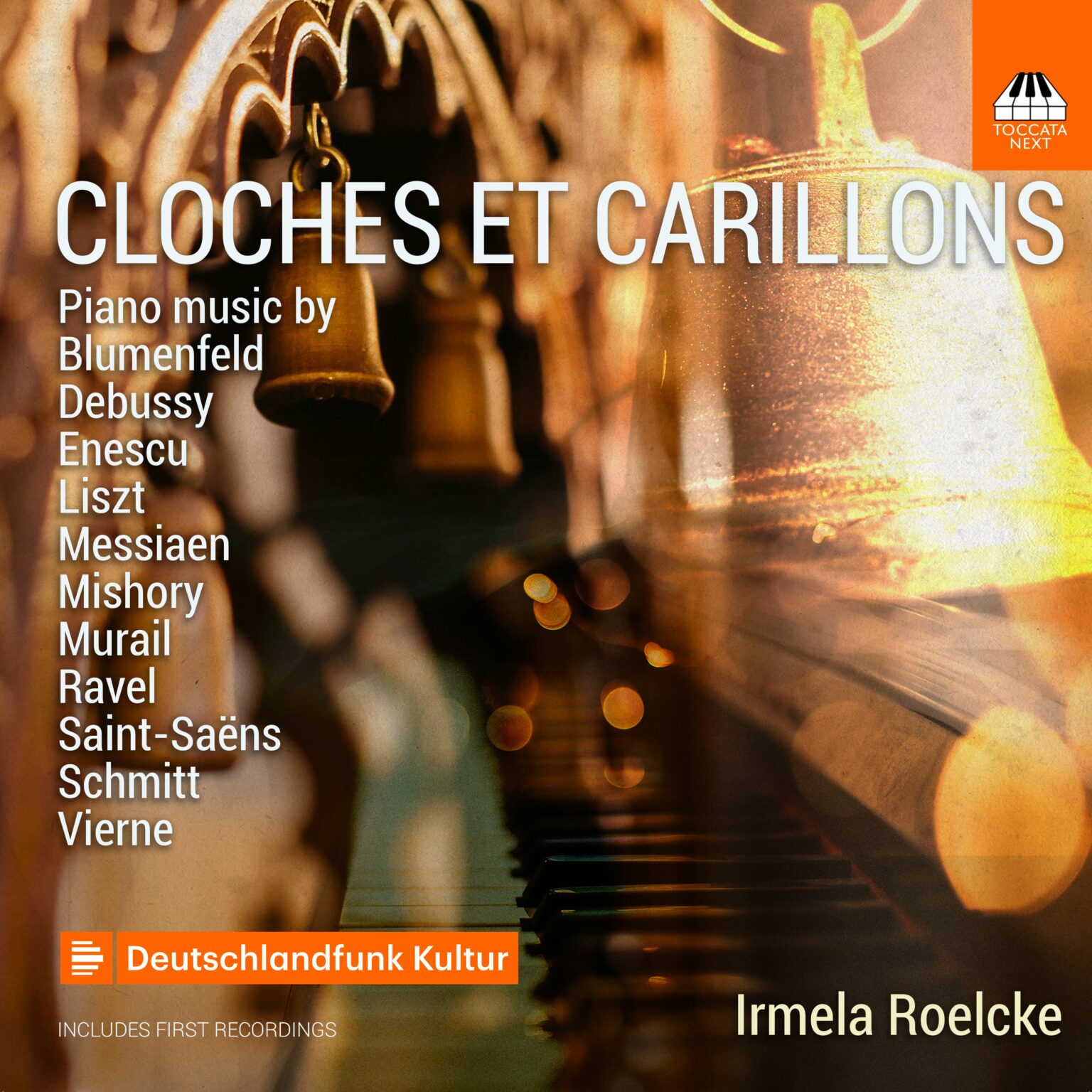
CLOCHES ET CARILLONS • Irmela Roelcke (pn) • TOCCATA 0020 (83:33)
SAINT-SAËNS Les cloches du soir. LISZT Weihnachtsbaum. Années de Pélerinage I: Les cloches de Genève. Ave Maria, “Die Glöcken von Rom.” SCHMITT Musiques intimes: Glas. VIERNE Poème des cloches funèbres: Le glas. BLUMENFELD Cloches, Suite pour piano. RAVEL Miroirs: La vallée des cloches. DEBUSSY Images, Book 1: Cloches à travers les feuilles. MESSIAEN Preludes: Cloches d’angoisse et larmes d’adieu. MURAIL Cloches d’adieu, et un sourire. MISHORY Cloches de joie et larmes de rire. ENESCU Piano Suite No. 3: Choral; Carillon nocturne
This is a remarkably imaginative and beautifully played program of piano music that evokes bells and carillons. German pianist Irmela Roelcke writes that the idea was inspired by two movements of George Enescu’s Piano Suite No. 3: “Choral” and “Carillon nocturne” are to be played without a break, the former evoking a church choir and the latter a memory of monastery bells from the village of Sinaïa, where Enescu wrote much of his music. I had not heard the two pieces before this disc, and immediately I understood how Roelcke was inspired by them to assemble and record this collection.
A program of bell music requires from the pianist, above all, an ability to elicit a wide range of colors from the keyboard, which Roelcke does splendidly. The quiet tintinnabulation heard in the upper register of the piano in Saint-Saëns’s Les cloches du soir is a far cry from the somber, dark-hued chimes recalled by Messiaen’s “Cloches d’angoisse et larmes d’adieu.” Roelcke has succeeded in mastering both extremes.
She has created a deeply engaging recital around a theme that might appear limiting. For the 83 minutes of this generously filled disc the listener is absorbed in the music because of the intelligent design of the program and the quality of the performances. Roelcke effectively balances the different voices in these 16 diverse pieces. For example, in Gilead Mishory’s Cloches de joie et larmes de rire (Bells of joy and tears of laughter), the most recent composition on the disc (2006), there is a constant interplay between the piano’s upper and lower registers; they are balanced perfectly in Roelcke’s hands. Similarly, in Enescu’s “Choral” her careful voicing of the chords assures that no note sticks out—the music really does evoke the blended sound of a church choir where all the voices sing as one. This is a reading of grandeur and beauty that flows naturally into the “Carillon Nocturne.”
Roelcke plays with great power and tonal depth in Louis Vierne’s imposing “Le glas” (Death knell), and with notable delicacy in Liszt’s “Les cloches de Genève.” Her mastery of both ends of the dynamic spectrum, as mentioned above, also includes every shade in between. The rich recorded sound and Jonathan Powell’s fine program notes round out a disc that I can recommend without reservation.
Henry Fogel
This article originally appeared in Issue 46:3 (Jan/Feb 2023) of Fanfare Magazine.